
The definitive Ethiopian coffee platform.
Connecting Ethiopian producers with the world's best roasters — market intelligence, verified exporters, and sourcing tools.
For Producers
Grow your
global reach.
- Reach buyers in 30+ countries
- Verified exporter badge
- Direct sample requests
- Dashboard & inquiry management
For Roasters & Buyers
Source Ethiopia
with confidence.
Free monthly market dispatch
- 200+ verified Ethiopian exporters
- Live market prices & EUDR data
- Expert sourcing guides
Five growing regions.
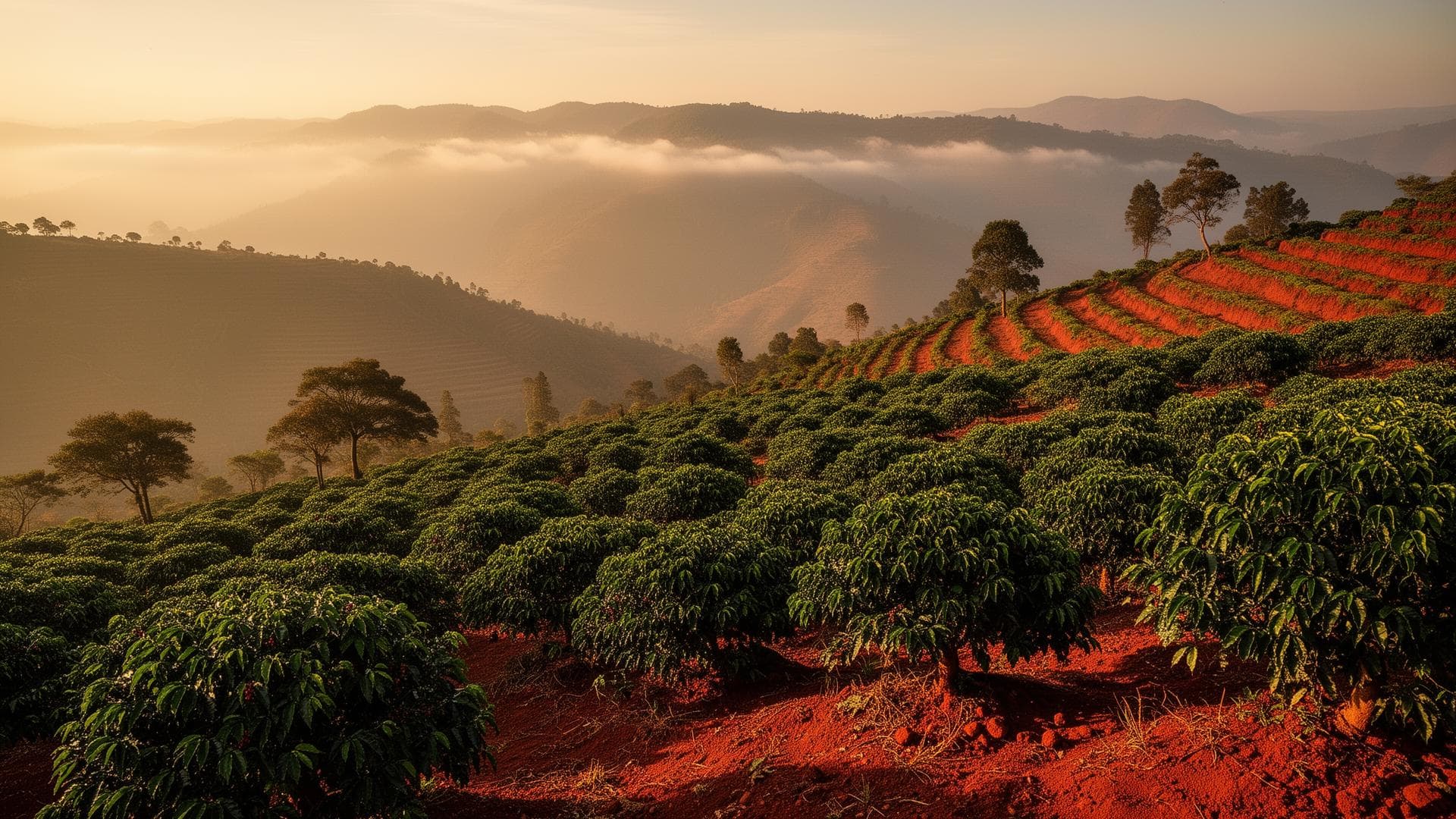
From the jasmine-scented highlands of Yirgacheffe to the wine-like wild naturals of Harrar — each region produces cup profiles that can't be replicated anywhere else.
Where coffee was born — and still grows wild.
Ethiopia is the genetic origin of Coffea arabica. Wild coffee trees still grow in the ancient forests of Kaffa, Bench Sheko, and Sheka — forests from which the word “coffee” itself derives. The country's extraordinary altitude range — from 1,400m in Harrar to over 2,200m in Yirgacheffe — combined with distinct wet and dry seasons, produces flavour profiles that can't be replicated anywhere else.
Ancient forests
Wild and semi-forest coffees grow beneath a canopy of native trees, producing cups with extraordinary complexity and aromatic depth.
Diverse terroir
Five distinct growing regions — each with unique microclimates, soil compositions, and traditional farming practices.
Production & Processing
Four production systems. Three processing methods. One origin.
Production Systems
Wild Forest
Coffee growing under native forest canopy with minimal human intervention. Most primitive and diverse.
Semi-Forest
Wild coffee managed and thinned by farmers. A transition between wild and cultivated.
Garden Coffee
Coffee grown alongside food crops in smallholder gardens. Most common production system.
Plantation
Large-scale commercial farms, some state-run, with modern agricultural practices.
Processing Methods
Washed (Wet)
Cherries pulped, fermented 36–72 hrs, then dried. Produces clean, bright, tea-like cups with transparent terroir expression.
Natural (Dry)
Whole cherries dried on raised beds for 14–28 days. Imparts intense fruit and wine-like notes. Ethiopia's oldest method.
Honey
Pulped but dried with mucilage intact. Bridges washed and natural profiles — controlled sweetness and fruit without the intensity.
Market intelligence
Price trends, export volumes, and compliance data for the Ethiopian coffee trade.
G1 Yirgacheffe Specialty Differential
+205¢/lb ↑ +63¢ (12 mo)
G1 Yirgacheffe — FOB differential above ICE NY C-Market
↑ 63¢ since Jun '24
ICO · ECTASource: ICO Monthly Coffee Market Report; Ethiopian Coffee & Tea Authority (ECTA) published differentials. Data: Jun 2024–May 2025.
EUDR Compliance
74%
exporters in compliance process
2023/24 Exports
278k MT
+8.2% year-on-year — USDA FAS
Container Rate
~$1,650
Djibouti–Rotterdam (TEU, May '25)
New-Crop Yirgacheffe
On market
2024/25 G1 washed lots available
Export Destinations 2023/24
Total 2023/24 exports · 278k MT (~4.63M 60-kg bags)
Source: USDA FAS PSD database; ECTA Annual Export Statistics 2023/24
Grade Export Split 2023/24
Total 2023/24 exports: ~278k MT — Source: USDA FAS / ECTA
Harvest & export calendar
Current status across all six Ethiopian growing regions — hover for detail.
| Region | Jan | Feb | Mar | Apr | May | Jun | Jul | Aug | Sep | Oct | Nov | Dec |
|---|---|---|---|---|---|---|---|---|---|---|---|---|
Yirgacheffe Gedeo Zone | E | E | C | C | C | |||||||
Sidama Sidama Region | E | E | C | C | C | |||||||
Guji Guji Zone | E | E | E | E | C | C | ||||||
Harrar East Hararghe | E | E | E | C | C | C | ||||||
Limu Jimma Zone | E | E | E | E | C | C | ||||||
Kaffa South West Ethiopia | E | E | E | E | C | C | C |
From cherry to container.
Ethiopian coffee passes through a rigorous chain from smallholder farm to international port. Understanding this process is essential for every buyer.
Farm & harvest
Smallholder farmers (avg. 0.5–2 ha) hand-pick ripe red cherries Oct–Jan. Ethiopia's agro-forestry systems grow trees alongside banana, enset, and shade trees.
Processing
Washed: cherries pulped, fermented 36–72 hrs. Natural: whole cherry dried on raised beds 3–6 weeks. Honey: pulped but dried with mucilage intact.
Grading & ECX
Green coffee is graded G1–G5 at ECX warehouses in Addis, Dire Dawa, or Jimma using physical and cup-quality criteria.
Export licence
Licensed exporters purchase at ECX or via direct specialty contracts, arranging fumigation, phytosanitary certificates, and CTA grade certificates.
Port & shipment
Most Ethiopian coffee departs via Djibouti Port or Berbera. Transit takes 5–10 days to port; ocean freight adds 3–5 weeks to Europe or Asia.
Sourcing intelligence.
Deep dives on Ethiopian coffee trade, grading, certifications, and direct sourcing — written for specialty buyers.
How to Source Ethiopian Coffee Directly in 2026
From finding the right exporter to landing your first container at port — what direct sourcing actually looks like in 2026.
Understanding Ethiopian Coffee Grading: G1, G2, G3
Grade 1 doesn't always mean 'better' — it means fewer defects. Here's what each grade tells you, and what it doesn't.
Washed vs Natural Process: What It Means for Your Roast
The single biggest variable in an Ethiopian coffee isn't the region — it's whether the cherry was sun-dried or washed.
Meet the exporters.
Each exporter is annually verified for export licence status, contract reliability, and active sample availability. No brokers — direct trade only.
200+ verified Ethiopian exporters
We're hand-vetting every listing — active export licences, live sample availability, EUDR compliance status, and direct contact details.
Grow your international buyer network.
Join the verified directory to showcase your coffee to specialty roasters, importers, and traders across 30+ countries. No brokerage fees — direct relationships only.
Verified Exporter
Premium Directory Listing
Practical tools for the trade
Checklists, guides, and reference sheets — free, printable, and written by Ethiopian coffee specialists.
Checklist · 1-page checklist
Ethiopian Coffee Buyer's Checklist
Download free
Guide · 12-page guide
How to Export Ethiopian Coffee
Download free
Reference · 6-page atlas
Ethiopian Coffee Varieties & Flavour Atlas
Download free
Handbook · 20-page handbook
The Ethiopian Coffee Sourcing Handbook
Download free
Identify any
Ethiopian bean
instantly.
Photograph green or roasted coffee beans with your camera. Our AI identifies the variety, region, processing method, and predicted cup profile in seconds.
Try the analyzer freeIdentified as
Yirgacheffe Grade 1 Washed
Gedeo Zone, SNNPR
Cup score
87–91
Altitude
1,800–2,200 m
Confidence
94%
Analysis completed in 2.8 seconds
The full guide,
in your pocket.
Live ECX prices, exporter contacts, harvest alerts, and AI-powered bean identification — all offline-capable for field use.
Join the waitlist
Early access · 6 months free · No spam
1,200+ buyers on the waitlist
Trade signals, harvest reports, exporter news.
One thoughtful email a month. Cup score updates, FOB price movements, and the conversations happening in the trade. No spam.